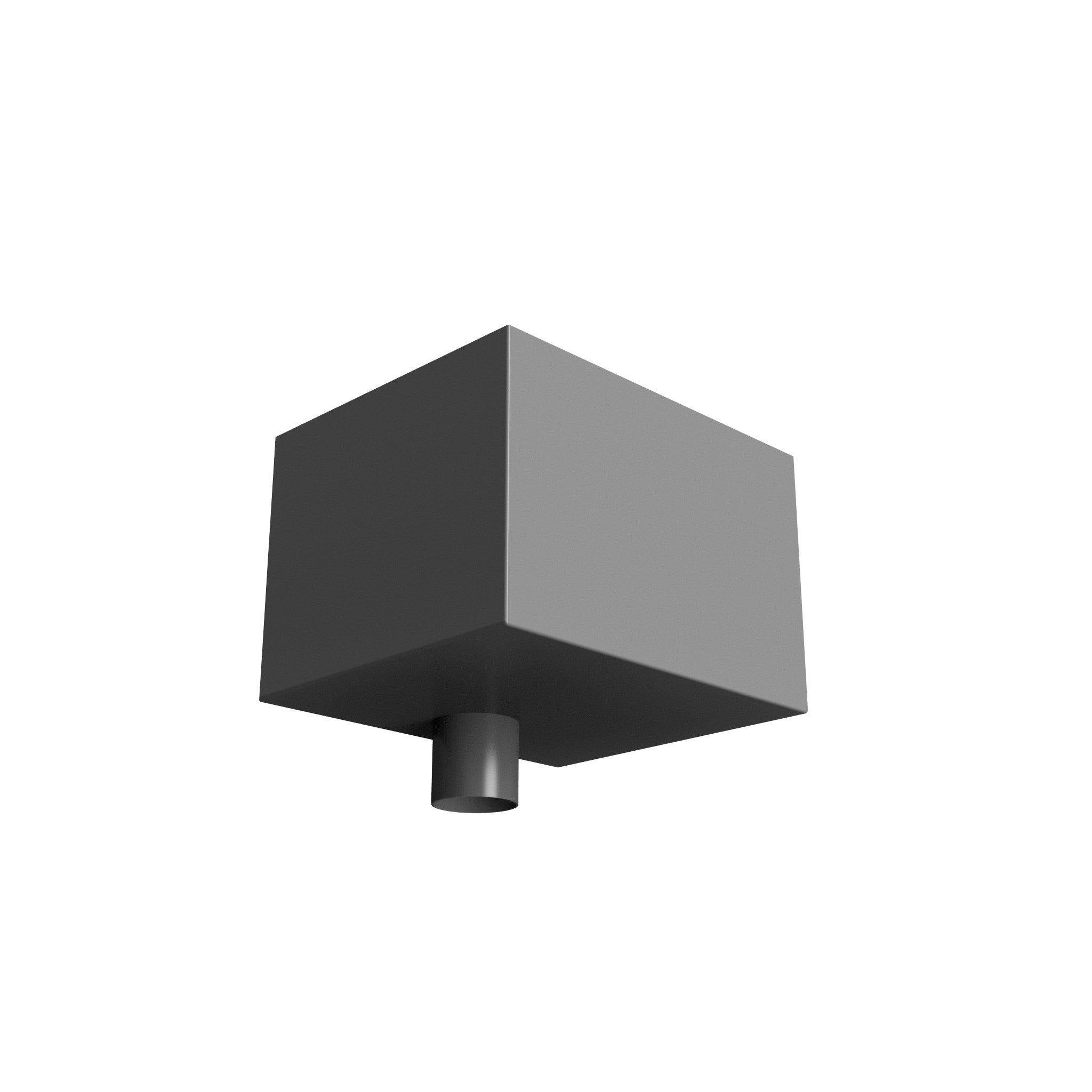
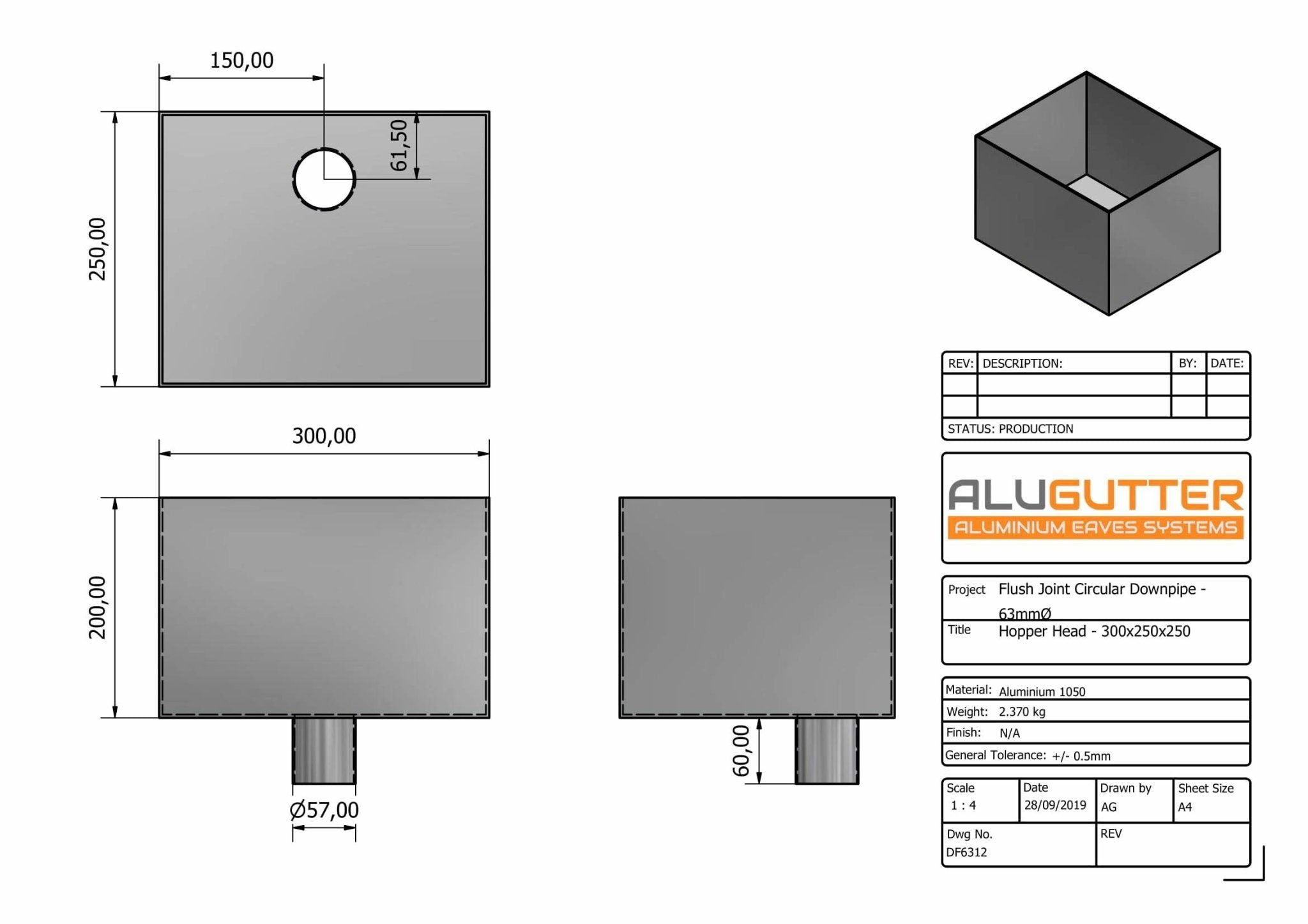
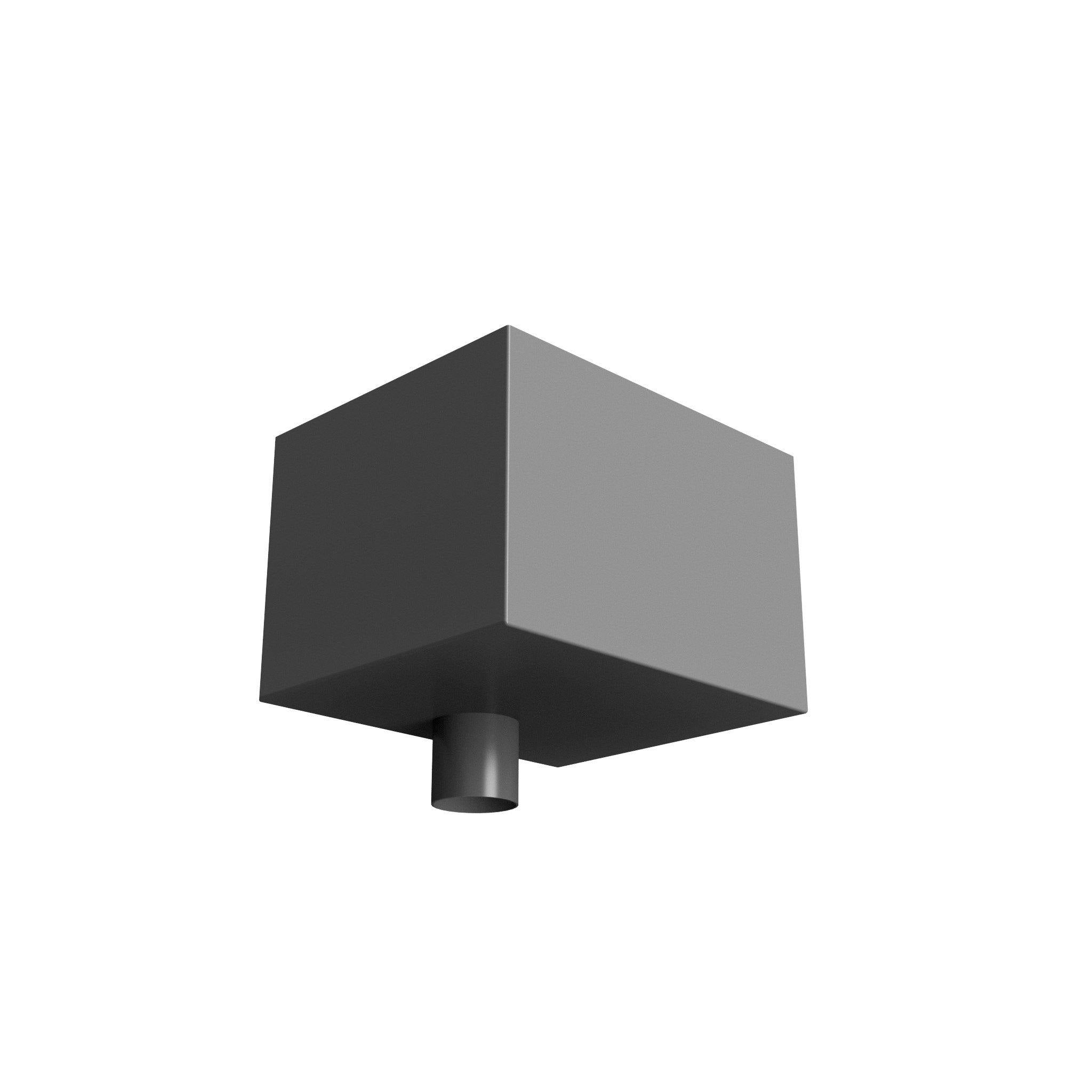
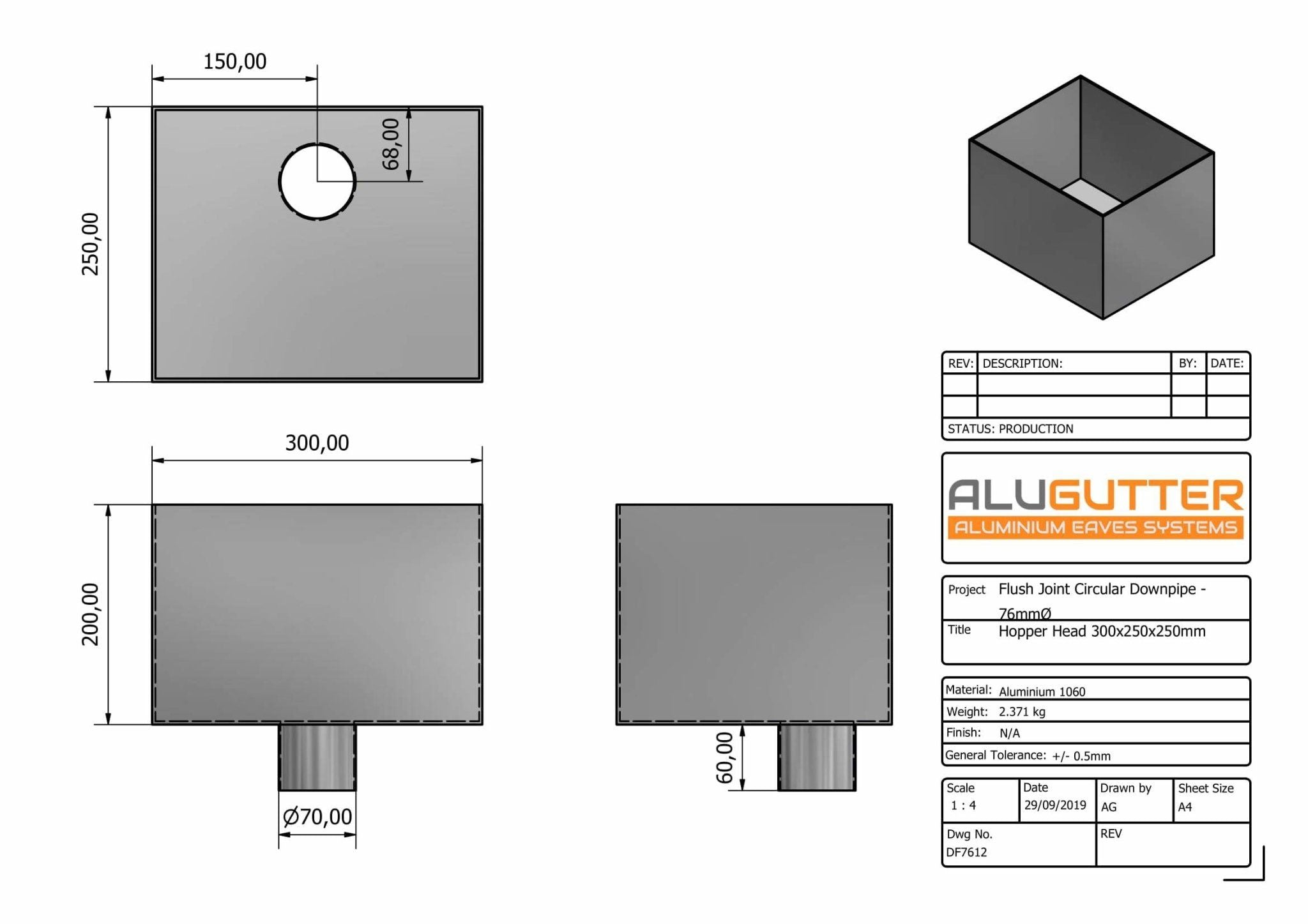
Aluminium hopper heads — also specified as aluminium rainwater heads — are essential components for collecting and directing rainwater from flat roof parapet wall openings, box gutter outlets, and downpipe junctions. Manufactured in the UK from high-quality aluminium, our hopper heads offer an impressive 50-year functional life expectancy, outstanding corrosion resistance, and a specification-grade finish that integrates seamlessly with both contemporary and heritage buildings.
We manufacture two distinct series: contemporary fabricated hopper heads, formed from 2mm marine-grade aluminium sheet for use with flush jointaluminium downpipes, and traditional cast aluminium rainwater heads, gravity cast from 5mm LM6 aluminium alloy for use with traditional downpipe profiles. Both series are available in 63mm circular, 76mm circular, and 72×72mm square outlets, and are powder-coated to order in any RAL or BS colour. For non-standard sizes or profiles, we also manufacture bespoke aluminium hopper heads to your exact specification.Contact Uswith your requirements for a free quotation.
What Is an Aluminium Rainwater Head?
The termshopper headandrainwater headrefer to the same component. "Rainwater head" is the correct architectural and specification term — used in technical drawings, NBS clauses, and planning documentation — whilst "hopper head" is the terminology most widely used in the trade and domestic market.
Functionally, an aluminium rainwater head is a box-shaped collector that gathers water from one or more sources — typically a flat roof parapet wall outlet, a box gutter running outlet, or two converging downpipes — and channels it into a single downpipe outlet below. Positioning hoppers at key collection points reduces the number of downpipes required and can significantly improve the visual appearance of a building's elevations. Our cast aluminium rainwater heads are particularly well-suited to listed buildings and heritage projects where traditional detailing is required, whilst our fabricated contemporary hoppers complement modern and commercial architecture.
Choosing the Right Hopper Head — DF-Series vs DT-Series
Selecting the correct series depends on the downpipe system installed. All product codes beginning withDFare designed for flush joint downpipe profiles; all codes beginning withDTare designed for traditional downpipe profiles. Both series connect directly without additional adaptors when matched correctly to the corresponding downpipe system.
Full dimensions and outlet specifications are provided on each individual product page. If you are unsure which system is installed or which series to select,Contact Usand our team will advise. For drainage calculations, ourDrainage Design CalculatorandProject Cost Estimatorare available free of charge.
Bespoke Aluminium Hopper Heads
Our standard range covers the most common residential and commercial applications, but we understand that many projects demand something more specific. For straightforward bespoke requirements, we can fabricate aluminium hopper heads from sheet to any size — ideal where standard dimensions do not suit a particular parapet opening, box gutter outlet, or architectural detail.
Bespoke hoppers are finished through our five-stage powder coating process in any RAL or BS colour, or supplied in mill finish.Contact Uswith your dimensions, outlet requirement, and desired finish for a free quotation. All bespoke items are manufactured to order and are non-returnable.
Our 5-Stage Powder Coating Process
At Alugutter, the finish applied to every hopper head is the product of a rigorous five-stage powder coating process — a level of preparation that most volume manufacturers do not carry out. The result is a specification-grade Interpon D1036 architectural finish with a 25-year decorative life expectancy when maintained correctly.
1. Hand Sanding
Before any chemical treatment, each component is hand-sanded using an air-powered sander. This labour-intensive step — avoided by most competitors — introduces controlled mechanical abrasion, creating a physical key in the aluminium surface that dramatically increases the surface area available for subsequent coating layers to grip.
2. Degreasing and Cleaning
The sanded component is thoroughly degreased to remove all manufacturing oils and surface contaminants. This stage follows — rather than replaces — the hand sanding, ensuring a pristine substrate for priming. Manufacturers who omit hand sanding begin their process here, accepting a measurably weaker adhesion foundation as a result.
3. Etch Primer Application
A specialist etch primer is applied to the prepared surface. The primer chemically reacts with the aluminium, creating a stable, chemically integrated foundation. This chemical bond is superior to a mechanical bond alone and significantly improves long-term resistance to peeling, flaking, and coating separation.
4. Electrostatic Powder Coat Application
The primed component is coated exclusively withInterpon D1036 external-grade architectural polyester powder. Applied electrostatically for full and even coverage, this top coat provides the colour, UV stability, and weather resistance required for permanent exterior architectural use. All standard RAL and BS colours are available, including RAL 7016 Anthracite Grey.
5. Oven Curing
The coated component enters a high-temperature oven where the polyester powder melts, flows, and chemically fuses to the primed aluminium substrate. This curing stage transforms the applied powder into a hard, durable decorative finish — permanently bonded to the substrate — forming the basis of the 25-year decorative life expectancy when the system is maintained correctly.
Stocked colours (RAL 7016 & Textured Black) dispatched in 5 working days
Fast turnaround for the most popular finishes — ideal for time-sensitive projects and installer programmes.
Direct connection to matching downpipe system — no additional fittings
DF-series connects directly to flush joint downpipes; DT-series to traditional profiles. Reduces installation time and material costs.
Bespoke fabrication from sheet aluminium to any size
Tailored solutions for non-standard parapet openings, box gutter outlets, and unique architectural requirements.
Lightweight — up to 60% lighter than cast iron
Easier single-operative handling and faster installation without compromising structural performance.
100% recyclable aluminium
Supports BREEAM and green building standards. No hazardous coatings or ongoing protective treatments required.
Aluminium Hopper Heads vs Alternative Materials
Compared to cast iron, steel, or PVC alternatives, aluminium rainwater heads offer a compelling combination of performance, aesthetics, and long-term value. Aluminium does not rust — unlike cast iron and steel — and requires no protective paint treatments to maintain its structural integrity. Unlike PVC, it will not become brittle or discolour with prolonged UV exposure and is not subject to the same degree of thermal expansion. For heritage applications, our gravity-cast LM6 aluminium rainwater heads replicate the appearance of traditional cast iron without the weight, the maintenance burden, or the susceptibility to rust.
Aluminium Hopper Head Installation Guide
Our aluminium hopper heads are straightforward to install and are suitable for both professional installers and competent DIY fitters.
Fixing
Secure the hopper through the rear using two pipe fixing screws for a stable wall mount. The bottom outlet spigot connects directly into the corresponding downpipe below — ensure the hopper series (DF or DT) and outlet size match the downpipe system for a secure, leak-free connection.
Flat Roof Connections
For flat roof parapet wall outlets, the rear of the hopper can be site-cut to accept a horizontal pipe from the roof surface. A 30–50mm profiled cut from the top lip conceals the connection neatly, prevents water overshoot, and ensures smooth drainage. Use appropriate cutting tools to maintain clean edges and apply touch-up paint to any cut surfaces.
Positioning
Position hopper heads at all principal collection points — parapet wall outlets, box gutter running outlets, and downpipe junctions. For corner applications, a bespoke corner hopper will maximise collection efficiency and maintain a clean appearance at the elevation. For full guidance, refer to ourInstallation Guides.
Maintenance Tips for Aluminium Hopper Heads
Aluminium hopper heads require minimal maintenance to retain both their performance and appearance. Clean annually using mild soap and water to remove debris, biological growth, and surface deposits. Avoid abrasive cleaners or wire brushes, which can damage the powder coat finish. In coastal or high-salinity environments, increase the frequency of cleaning to prevent salt deposit buildup. Touch-up paint is available for minor surface damage to the powder coat. Maintaining the finish correctly is important to achieving the full 25-year decorative life expectancy. For full guidance, visit ourMaintenance Guide.
What is the difference between a hopper head and a rainwater head?
The terms are interchangeable and refer to the same component. "Rainwater head" is the correct architectural and specification term — used in technical drawings, NBS clauses, and planning documentation — whilst "hopper head" is the term most widely used in the trade and domestic market. Both describe a box-shaped collector fitted at the top of a downpipe to gather water from flat roof parapet wall outlets, box gutter outlets, or converging drainage runs.
Which series do I need — DF or DT?
DF-serieshopper heads are designed for contemporary flush jointaluminium downpipesand connect directly without additional adaptors.DT-serieshopper heads are designed for traditional socket-type downpipe profiles. Both series are available in 63mm circular, 76mm circular, and 72×72mm square outlet sizes. If you are uncertain which system is installed,Contact Usand our team will advise.
What is the difference between the contemporary fabricated and traditional cast hoppers?
Our contemporary DF-series hoppers are fabricated from 2mm marine-grade aluminium sheet, producing a clean, angular profile suited to modern and commercial architecture. Our traditional DT-series hoppers are gravity cast from 5mm LM6 aluminium alloy — a denser, heavier construction that replicates the robustness and detailing of traditional cast iron rainwater heads, making them the preferred choice for heritage, listed, and period properties.
How long do aluminium hopper heads last?
Our aluminium hopper heads have a functional life expectancy of 50 years. The Interpon D1036 architectural powder coat finish has a decorative life expectancy of 25 years if maintained correctly — the finish is over-paintable, allowing the decorative lifespan to be extended further with routine upkeep. Aluminium does not rust, corrode, or require protective treatment, and demands only routine cleaning to maintain its structural performance.
Can aluminium hopper heads be used on flat roofs?
Yes. Our DF-series contemporary fabricated hopper heads are specifically suited to flat roof parapet wall outlet applications. The rear of the hopper can be site-cut on installation to accept a horizontal pipe from the roof surface. A 30–50mm profiled cut from the top lip conceals the connection, prevents water overshoot, and ensures clean drainage flow into the downpipe below.
What colours are available, and how long does delivery take?
All hopper heads are available in any RAL or BS colour, finished in Interpon D1036 external-grade architectural powder coat.RAL 7016 Anthracite GreyandTextured Blackare stocked and dispatched within 5 working days. All other colours are manufactured to order with a 10-working-day lead time and are non-returnable as made-to-order items. Mill finish is available for bespoke applications on request.
Can I order a bespoke aluminium hopper head?
Yes. For straightforward bespoke requirements, we can fabricate aluminium hopper heads from sheet to any size — ideal where standard dimensions do not suit a particular parapet opening or box gutter outlet. Bespoke hoppers are finished in any RAL or BS colour through our five-stage powder coating process, or supplied in mill finish.Contact Uswith your dimensions and outlet requirement for a free quotation. All bespoke items are made to order and non-returnable.
Why choose Alugutter over other aluminium hopper head suppliers?
Alugutter is a UK manufacturer, not a distributor. Every hopper head is produced in-house, giving us full control over material quality and the powder coating process. Our five-stage finish — beginning with hand sanding, a step the majority of competitors omit entirely — produces a superior decorative result with a 25-year decorative life expectancy when maintained correctly, against a 50-year functional life expectancy for the aluminium itself. Stocked colours are dispatched in 5 working days, and our bespoke fabrication capability means non-standard requirements can be accommodated.
Our aluminium hopper heads and rainwater heads provide a durable, low-maintenance, and aesthetically flexible solution for any rainwater management project. Browse the range above, use ourProject Cost Estimatorfor a budget indication, orContact Usfor bespoke advice and fast UK delivery.