
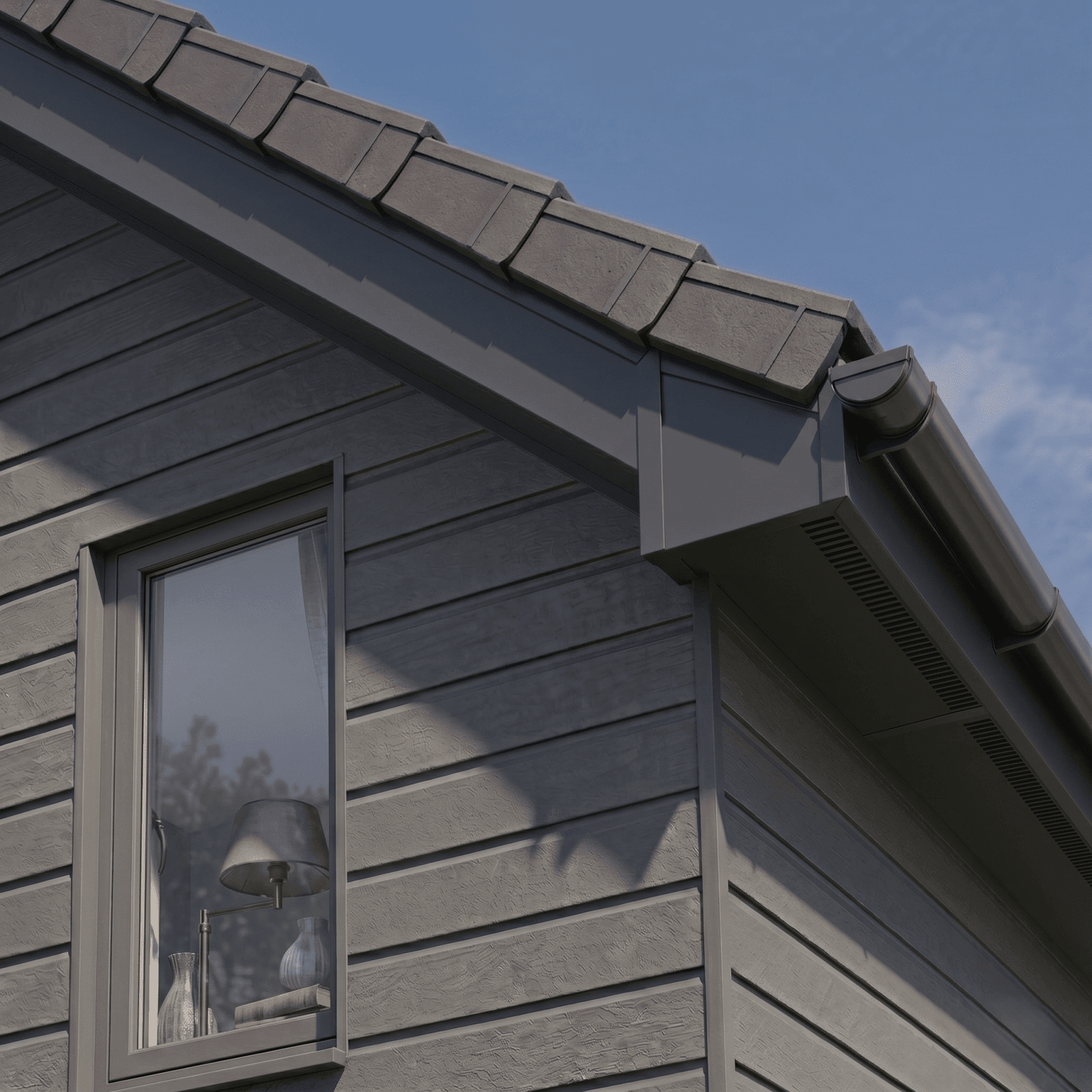
Fascia and soffit ventilation allows a continuous flow of air into the roof space at the eaves, removing the warm, moist air that causes condensation, damp and timber decay. Under BS 5250:2021, a standard cold pitched roof over 15° requires ventilation equivalent to a continuous 10mm opening at the eaves, rising to 25mm for shallower pitches and warm roofs, with an additional 5mm at high level in many cases. This is achieved using vented soffit boards, over-fascia vent strips, circular soffit vents or roof and ridge vents, often in combination.
Replacing your fascia and soffit boards is one of the most effective upgrades you can make to protect your roofline. A common and costly mistake, however, is to seal the eaves with a smart new roofline while cutting off the airflow the roof space depends upon. Inadequate roofline ventilation is one of the leading causes of condensation, damp and timber decay in UK lofts.
This guide explains why roof ventilation matters, how it works, what the current standards require, and the methods available to achieve it, including where our aluminium fascia and soffits fit into a complete ventilation strategy.
Why Roofline Ventilation Matters
Warm, moist air is generated continually inside every home through cooking, bathing and everyday living. That air rises and finds its way into the roof space. If it cannot escape, it condenses on the cold surfaces of the roof structure, leading to damp insulation, mould growth, decay of roof timbers and reduced thermal performance.
Older timber fascia and soffit boards were rarely airtight, so air leaked into the loft almost by accident. Fitting new, precisely installed boards without designed-in ventilation can inadvertently remove that airflow, which is why condensation problems frequently appear shortly after a roofline replacement. Designing ventilation into the work is therefore essential, not optional.
Signs of Inadequate Ventilation
How Roofline Ventilation Works
Effective roof ventilation relies on cross-flow: cool, dry air is drawn in at low level along the eaves, travels through the roof space, and carries moisture out at high level near the ridge. Air entering at the eaves alone is rarely sufficient; a balanced system needs both an intake and an outlet to keep air moving.
Ventilation Requirements (BS 5250:2021)
Roof ventilation in the UK is governed by BS 5250:2021, the code of practice for the management of moisture in buildings, read alongside Approved Document C (resistance to moisture) and Approved Document F (ventilation). The required ventilation is expressed as an equivalent continuous opening and depends on the roof type and pitch.
| Roof Type | Pitch | Low Level (Eaves) | High Level (Ridge) |
|---|---|---|---|
| Cold roof | Over 15° | 10mm continuous | 5mm if pitch > 35° or span > 10m |
| Cold roof | 15° or less | 25mm continuous | 5mm recommended |
| Warm roof | Any pitch | 25mm continuous | 5mm required |
Figures are equivalent continuous free areas. A cold roof has insulation at ceiling level with a cold loft void above; a warm roof has insulation following the rafter line. BS 5250:2021 takes a whole-building approach, so the underlay type and the airtightness of the ceiling also influence the strategy. Complex roof designs should be referred for specialist advice.
One point is worth emphasising, because it is often overlooked. Many ventilation diagrams show only the low-level eaves figures and omit the high-level requirement. For a warm roof, a continuous 5mm opening near the ridge is required in addition to the 25mm at the eaves, and for steeper or larger cold roofs the same high-level provision applies. Ventilating at the eaves alone is not enough.
Ways to Ventilate the Roofline
There are several methods of introducing ventilation, and they are frequently combined to achieve both the low-level intake and the high-level outlet. Alugutter manufactures and supplies vented aluminium soffit boards. The other methods below are widely available from roofing merchants and may be used alongside our soffit boards to build a complete, compliant system.
| Method | Position | Typical Use | Supplied by Alugutter |
|---|---|---|---|
| Vented soffit boards | Low level (eaves) | Primary intake on a new or replacement roofline | Yes |
| Over-fascia vent strip | Low level (behind the gutter) | Solid or narrow soffits, or for additional free area | Available on the market |
| Circular soffit vents | Low level (eaves) | Retrofitting ventilation to existing soffits | Available on the market |
| Roof tile & slate vents | High level (roof slope) | Outlet on the roof slope | Available on the market |
| Ridge vents | High level (ridge) | Continuous high-level outlet | Available on the market |
Alugutter Vented Aluminium Soffit Boards
Our vented soffit boards are manufactured in-house from 2mm marine-grade 1050 aluminium and finished in architectural-grade polyester powder coating for a 50-year functional life and a 25-year decorative life. The vented option delivers a 25mm continuous airflow equivalent, providing reliable low-level intake at the eaves, while retaining the clean, contemporary appearance of a solid board.
At a 25mm continuous airflow equivalent, our vented soffit meets the low-level (eaves) ventilation requirement for every roof type and pitch under BS 5250:2021, from the 10mm needed for a cold pitched roof over 15° up to the 25mm needed for shallow-pitch and warm roofs. It is important to note that warm roofs, and cold roofs over 35° or with spans exceeding 10m, additionally require a separate 5mm continuous opening at high level. This high-level provision is achieved with roof, tile or ridge vents, which work in tandem with the soffit to complete the cross-flow.
Boards are available in widths of 180mm, 365mm, 490mm and 740mm, in both vented and unvented styles, and in a wide range of RAL colours including RAL 7016 Anthracite Grey and RAL 9005 Black. As made-to-order items, fascia and soffit products carry a lead time of 10 working days. View the full range of aluminium fascia and soffits.
"Ventilation is not an optional extra on a roofline replacement. A beautifully finished fascia and soffit that seals the eaves without providing airflow will trap moisture and undo the very protection it was intended to deliver."
— Alugutter Technical TeamPeople Also Ask
In most cases, yes. Where the roof relies on the eaves for its low-level air intake, vented soffits are needed to allow air into the roof space and control moisture. The exception is roof designs that are ventilated by other means, such as a dedicated ridge or tile-vent system, so the strategy should be assessed for the specific roof.
This usually means the new boards have sealed the eaves without replacing the ventilation the loft previously relied upon. Older timber boards often leaked air, so airflow was lost when they were replaced with closed boards. Introducing vented soffits or over-fascia vents restores the low-level intake and resolves the problem.
A vented soffit board has ventilation slots that allow air to pass into the roof space, whereas an unvented board is solid. Unvented boards are used where ventilation is provided elsewhere, for example by over-fascia vents or a high-level system. Our vented soffit provides a 25mm continuous airflow equivalent through 40 × 5mm slots, which meets the low-level eaves requirement for every roof type.
In most cases, no. Our vented soffit already delivers the full 25mm low-level airflow, which satisfies the eaves requirement for every roof type. Over-fascia vents are mainly used where the soffit is solid or unvented, or where the eaves detail makes a vented soffit impractical; they sit on top of the fascia behind the gutter and provide an alternative route for low-level air.
Under BS 5250:2021, a cold pitched roof over 15° requires a continuous 10mm opening at the eaves, increasing to 25mm for pitches of 15° or less and for warm roofs. A continuous 5mm opening near the ridge is also required for warm roofs and for steeper or larger cold roofs. The figures are equivalent continuous free areas across the eaves.
Yes. Circular soffit vents can be fitted into existing soffit boards to introduce ventilation without a full replacement, and roof or ridge vents can be added at high level. Where the roofline is being replaced, however, specifying vented aluminium soffit boards from the outset is the cleaner and more durable solution.
Browse our range of aluminium fascia and soffits, manufactured in-house from 2mm marine-grade aluminium and available vented or unvented in a wide range of RAL colours. For advice on the right ventilation strategy for your roof, our technical team is happy to help.
Shop Fascia & Soffits Contact UsBrian Bell is a joint owner of Alugutter, with over 25 years of experience as a technical expert and product designer. Prior to founding Alugutter, he served as head of technical services at a multinational organisation, and he has contributed to BS EN standards committees developing standards to enhance product quality and compliance across the sector.