
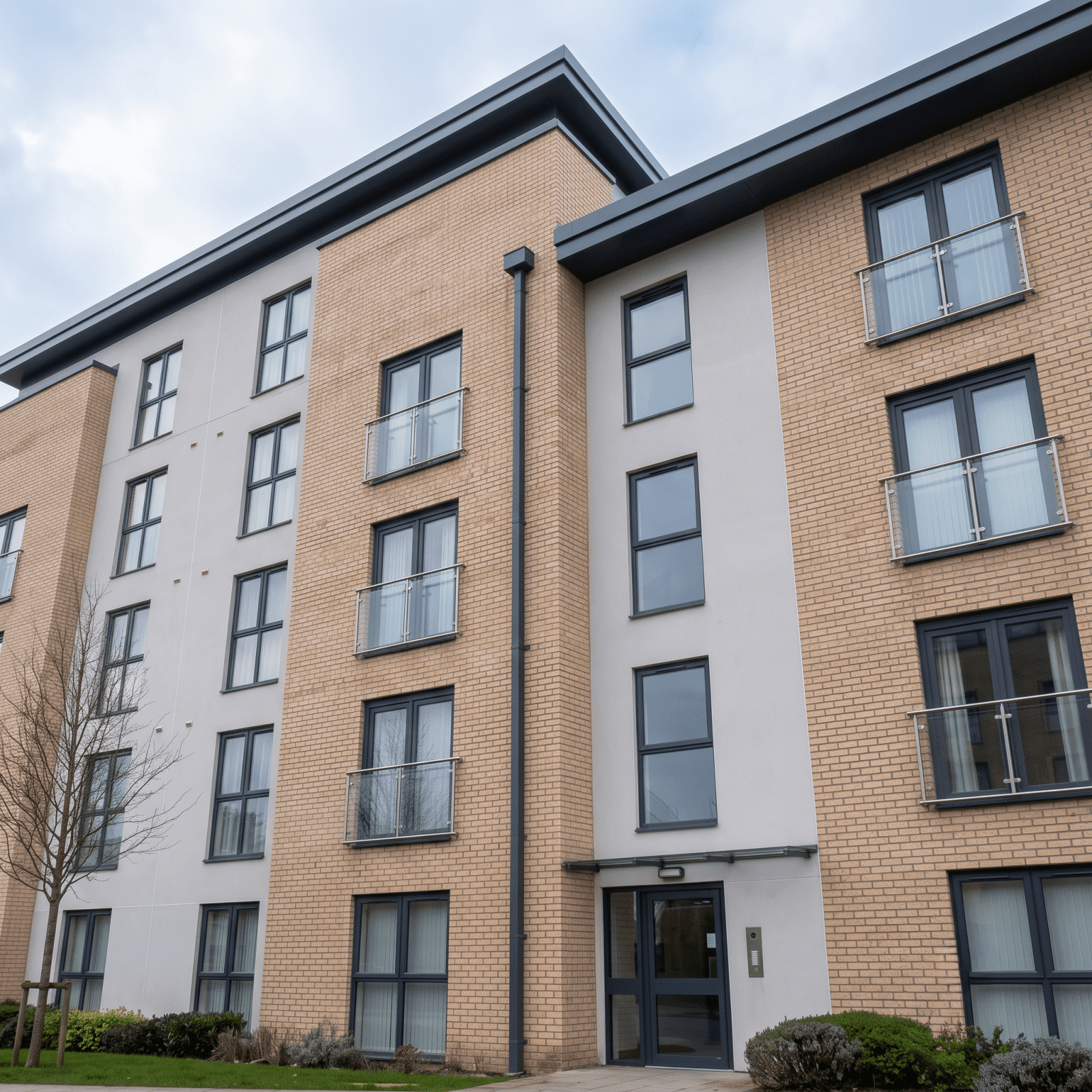
Fire rated rainwater systems for high-rise buildings must achieve European Class A1 or A2-s1,d0 under BS EN 13501-1. Regulation 7(2) of the Building Regulations bans combustible materials, including uPVC rainwater goods, from the external walls of residential buildings with a storey 18 metres or more above ground, and statutory guidance now extends similar expectations to residential buildings over 11 metres. Powder-coated aluminium is classified A2-s1,d0, which is why every Alugutter gutter, downpipe, fascia, soffit and coping can be specified on any building, at any height, without restriction.
Since the Grenfell Tower fire, the fire performance of every component on the outside of a building has come under scrutiny. Cladding dominates the headlines, but gutters, downpipes, fascias, soffits and copings are all fixed to, or form part of, the external envelope — and the regulations treat them accordingly. Specify the wrong material and a rainwater system can carry flame across a facade, shed burning droplets and fail precisely when it matters most.
This guide explains what Approved Document B and Regulation 7(2) require of rainwater goods and roofline products, what the A2-s1,d0 classification actually means, and how a fully non-combustible aluminium roofline satisfies the requirements on high-rise residential buildings, schools, hospitals, student accommodation and every other building type. It is written for contractors, specifiers and architects, and it is general guidance rather than a substitute for a project-specific fire strategy.
Why Fire Safety Now Drives Rainwater Specification
For decades, rainwater goods were selected on cost, flow capacity and appearance alone. That changed with the Building (Amendment) Regulations 2018, which responded to the Grenfell Tower fire by banning combustible materials from the external walls of higher-risk residential buildings. The ban applies to the entire external wall construction and its specified attachments — not just the cladding — and rainwater goods fixed to the face of the building fall squarely within its scope.
The practical consequence is straightforward. A uPVC downpipe running the full height of a tall building is a continuous strip of combustible material connecting one storey to the next. In a fire, uPVC softens, melts and can release burning droplets, allowing flame to travel across the external surface and down onto whatever lies below. A non-combustible system does none of these things, which is why aluminium rainwater systems have become the default specification on buildings where height, occupancy or evacuation strategy raises the stakes.
Fire Rated Rainwater Systems: What the Regulations Require
Regulation 7(2) of the Building Regulations 2010 (as amended) requires that every material which becomes part of an external wall, or a specified attachment, of a “relevant building” achieves European Class A1 or A2-s1,d0 when classified to BS EN 13501-1. Relevant buildings are those with a storey at least 18 metres above ground level that contain dwellings, an institution, or rooms for residential purposes — including blocks of flats, hospitals, care homes, student accommodation and dormitories in boarding schools — and, since December 2022, hotels, hostels and boarding houses. Rainwater goods are not among the components exempted by Regulation 7(3), so gutters and downpipes on these buildings must meet the A1 or A2-s1,d0 standard.
The 2022 amendments to Approved Document B went further, introducing statutory guidance that restricts combustible materials on residential buildings with a storey over 11 metres. The direction of travel is unmistakable: on any building of height, and on any building where occupants are vulnerable or evacuation is complex, non-combustible external components are the expected specification.
| Building Type & Height | Requirement for External Wall Materials & Attachments |
|---|---|
| Relevant buildings — storey 18m+ (flats, hospitals, care homes, student accommodation, boarding school dormitories, hotels, hostels) | Legal requirement: Class A1 or A2-s1,d0 only (Regulation 7(2)). Combustible rainwater goods such as uPVC cannot be used. |
| Residential buildings — storey 11–18m | Statutory guidance: Approved Document B (2022 amendments) restricts combustible materials in external walls. Non-combustible rainwater goods are the prudent specification. |
| Schools, public buildings and all other buildings | No blanket ban, but requirement B4 of the Building Regulations (external fire spread) always applies, and best-practice guidance such as BB100 for schools favours non-combustible external components. |
Height is measured to the top floor surface of the top storey from the lowest adjacent ground level. This table summarises the position in England; Scotland, Wales and Northern Ireland operate their own regimes, and the requirements of a project-specific fire strategy always take precedence.
Understanding A2-s1,d0 — and Why uPVC Cannot Comply
BS EN 13501-1 classifies a construction product across three dimensions: its contribution to fire, its smoke production and whether it sheds flaming droplets. The classification A2-s1,d0 means the product makes no contribution to a fully developed fire and does not increase the fire load (A2), produces minimal smoke — the best available smoke classification (s1) — and releases no flaming droplets or particles (d0). The classification is arrived at through two tests: EN ISO 1716, which measures gross calorific value, and BS EN 13823, the Single Burning Item test, which assesses fire growth rate, total heat release and smoke production.
| Material | BS EN 13501-1 Class | Suitable Above 18m? |
|---|---|---|
| Mill-finish aluminium | A1 — non-combustible | Yes |
| Polyester powder-coated aluminium | A2-s1,d0 — no contribution to fire | Yes |
| Cast iron / steel | A1 (uncoated) | Yes, but heavy at height and requires ongoing corrosion protection |
| uPVC | Combustible — cannot achieve A1 or A2-s1,d0 | No — prohibited on relevant buildings |
On a coated aluminium product, the aluminium substrate is inherently non-combustible and classified A1; it is the coating that requires testing. Alugutter finishes every product with Interpon D1036, the external-grade architectural polyester powder coat from AkzoNobel’s Interpon D range. Applied to an aluminium substrate at 60–90 microns, this coating system has been independently tested and certified to achieve A2-s1,d0 under BS EN 13501-1:2018 by Warringtonfire Testing and Certification Limited (Notified Body 0833, Report No. WF 419155) and independently confirmed by CSTB (Classification Report RA18-0083). The Interpon D range has also been tested to BS 476 Parts 6 & 7, achieving Class 0 — the highest classification under the legacy UK standard, with Class 1 surface spread of flame — and to BS 6853:1999 Category Ia and EN 45545-2 HL3, the most demanding fire performance requirements for London Underground and rail applications.
This is why the fire safety section of every Alugutter product data sheet states that our products fully conform with Approved Document B and may be used on any part of any building, at any height, without restriction.
A Fully Non-Combustible Roofline for High-Rise Buildings
Compliance is only as strong as the weakest component. Specifying a non-combustible downpipe next to a uPVC fascia defeats the object, which is why Alugutter manufactures the complete external package — gutters, downpipes, hoppers, fascias, soffits and copings — from aluminium, in-house at our Bedford factory, all finished in the same certified A2-s1,d0 coating system.
Gutters. Our aluminium gutters are extruded from 6063 T6 hardened aluminium in half round, deepflow and box profiles, with box gutter fittings precision cut and welded from the same alloy. Flow capacity can be matched to the effective roof area of large or complex roofs, and rise and fall brackets, union connectors, stop ends and running outlets are all manufactured in aluminium — there are no combustible fittings hidden within the system.
Downpipes. On a tall facade the downpipe is the component that matters most, as it forms a continuous vertical line between storeys. Our aluminium downpipes are non-combustible over their full height, rigid enough to resist impact at ground level, and available in flush joint profiles whose clips hold the pipe just 5mm from the wall face — a detail that doubles as an effective anti-climb measure on residential blocks, schools and secure sites.
Fascias and soffits. Timber roofline burns and uPVC roofline melts; neither belongs at the eaves of a building where fire could enter the roof void. Our aluminium fascia and soffits are folded from 2mm thick 1050 grade aluminium sheet on our 3-metre press brakes, with bargeboards, box ends and ventilation provision fabricated to order, giving the eaves the same fire performance as the rest of the envelope.
Wall copings. High-rise and flat-roofed buildings almost always terminate in a parapet, and the capping that weatherproofs it sits at the very top of the external wall. Our aluminium wall copings are fabricated from 2mm 1050 grade sheet on 3mm aluminium brackets with a secret fix mechanism, made to measure for any wall width, providing a non-combustible drip edge detail where uPVC or timber-based cappings would introduce risk.
Full dimensional and material specifications for the range are set out in our specification guide for architects, with CAD drawings and product data sheets available to download for every profile.
Beyond Compliance: Why Aluminium Is Right at Any Height
Certified fire performance. Every product in the range achieves A2-s1,d0 to BS EN 13501-1:2018 — permitted on any building, at any height, without restriction.
Lightweight at height. A fraction of the weight of cast iron, reducing structural loading, simplifying fixing into the facade and making installation from scaffold or MEWP faster and safer.
Rigidity and impact resistance. 6063 T6 hardened extrusions and 2mm sheet withstand ladder strikes, maintenance traffic and ground-level impacts that crack uPVC.
50-year functional life. With a 25-year decorative life and an over-paintable finish — critical on tall buildings where every future access for replacement means scaffolding or rope access costs.
Superior coating adhesion. Every component is hand-sanded before powder coating — not merely degreased — so the Interpon D1036 finish, applied to BS EN 12206-1, stays bonded for decades of exposure.
Made to order, in-house. Manufactured in our Bedford factory using 3m press brakes, laser welding and our own powder coating plant, in any RAL colour including RAL 7016 Anthracite Grey, at factory-direct prices.
“On a building of height, the rainwater system is part of the fire strategy whether the specifier intends it or not. A continuous run of combustible material on the facade is a risk that no longer needs to be taken — a certified A2-s1,d0 aluminium system removes it entirely, on any building, at any height.”
— Alugutter Technical Team
People Also Ask
What material should rainwater downpipes be for high-rise buildings?
Downpipes on high-rise residential buildings should be a non-combustible material achieving Class A1 or A2-s1,d0 to BS EN 13501-1, such as aluminium. On relevant buildings with a storey 18 metres or more above ground, this is a legal requirement under Regulation 7(2) of the Building Regulations. Powder-coated aluminium combines the required fire classification with low weight, high rigidity and a 50-year functional life, making it the practical choice at height.
What fire rating do downpipes and gutters need?
On relevant buildings with a storey over 18 metres, rainwater goods must achieve European Class A1 or A2-s1,d0 under BS EN 13501-1:2018; no lower classification is permitted. On residential buildings between 11 and 18 metres, statutory guidance in Approved Document B restricts combustible materials, so the same classification is the prudent specification. On all other buildings there is no blanket requirement, but requirement B4 on external fire spread always applies.
Are uPVC gutters and downpipes allowed on buildings over 18 metres?
Not on relevant buildings. uPVC is a combustible material and cannot achieve the A1 or A2-s1,d0 classification that Regulation 7(2) requires for materials forming part of the external wall or its specified attachments on residential buildings with a storey 18 metres or more above ground. Rainwater goods are not among the components exempted by Regulation 7(3), so uPVC systems cannot be specified on these buildings.
Do fascia and soffit boards need to be non-combustible?
Where they form part of the external wall of a relevant building over 18 metres, yes — they must achieve A1 or A2-s1,d0, which rules out uPVC and untreated timber roofline. On lower buildings there is no blanket ban, but the eaves are a recognised route for fire to enter the roof void, and 2mm aluminium fascia and soffit boards give the roofline the same non-combustible performance as the rest of the envelope at any height.
Does the combustible materials ban apply to schools?
The Regulation 7(2) ban applies to boarding school dormitories with a storey over 18 metres, but ordinary day schools are not “relevant buildings” in law. In practice, however, fire safety design guidance for schools (BB100) and the duty to limit external fire spread lead most specifiers to select non-combustible external components for school buildings regardless of height. A2-s1,d0 aluminium rainwater and roofline systems satisfy both the guidance and the duty without compromise.
Is powder-coated aluminium A1 or A2-s1,d0?
The aluminium substrate itself is non-combustible and classified A1; once an organic powder coating is applied, the coated system is tested and classified as A2-s1,d0. Alugutter’s Interpon D1036 coating, applied at 60–90 microns, is certified A2-s1,d0 to BS EN 13501-1:2018 by Warringtonfire (Report No. WF 419155) and confirmed by CSTB (Report RA18-0083). Both A1 and A2-s1,d0 satisfy Regulation 7(2), so coated aluminium is fully compliant on any building at any height.
Every Alugutter gutter, downpipe, fascia, soffit and coping is manufactured in-house from certified non-combustible aluminium, finished in an A2-s1,d0 coating system, and supplied with the product data sheets and CAD drawings your fire strategy demands. Whether the project is a residential tower, a school, a hospital or a two-storey home, our technical team can help you specify a fully compliant roofline — at factory-direct prices.
Contact UsBrian Bell is a joint owner of Alugutter, with over 25 years of experience as a technical expert and product designer. Prior to founding Alugutter, he served as head of technical services at a multinational organisation, and he has contributed to BS EN standards committees developing standards to enhance product quality and compliance across the sector.